Origins TCG combineert gelijktijdige beslissingen, drie banen en wisselende locatie-effecten. Je hoeft niet elke kaart te kennen voordat je speelt. Begin met één vraag: kun je uitleggen wat er in je laatste ronde gebeurde? Dit overzicht helpt je de volgende nuttige gids te kiezen.
1. Installeer het spel en begrijp de kosten
Je eerste stappen: installeer het hoofdspel via Steam, volg de accountstappen en speel de tutorial.
Gratis of betaald?: onderscheid spelprogressie van verzamelkaarten en betaalde extra’s.
De kaarten voor competitief spelen zijn via het spel te verdienen. Verzamelen en leren spelen zijn verschillende doelen; je kunt met spelen beginnen. Volg de actuele opdrachten in jouw versie wanneer een oude video andere voortgangseisen toont.
2. Begrijp een ronde voordat je van deck wisselt
Een partij uitgelegd: barrières, locaties, plannen, onthullen en gevechten, met bordafbeeldingen.
Bekijk na een partij wat je niet kon verklaren. Was het een vaardigheid, een locatie of de volgorde van effecten? Eén interactie begrijpen helpt meer dan een lange namenlijst onthouden.
3. Leer één plan en verbeter het
Je eerste deck bouwen: kies een duidelijk plan, bekijk de kosten en test één wijziging tegelijk.
Speel een kleine reeks met hetzelfde deck. Herken eerst een speelbare opening en een nuttig antwoord. Je hoeft nog niet te bewijzen dat je het beste deck van de huidige meta hebt.
Gebruik de bibliotheek voor een gerichte vraag
Open de kaartenbibliotheek en zoek een naam of trefwoord. Standaard zie je kaarten op de huidige spellijst. Oudere of onbevestigde kaarten staan onder Meer filters. De statistieken hebben een datum: tekst op een kaartafbeelding kan uit een andere versie komen.
Een haalbaar doel voor je volgende sessie
Maak zo nodig eerst de tutorial af. Speel enkele partijen met één deck en schrijf één beslissing op die je anders zou nemen. Lees daarna de gids die daarbij helpt. Voor een ander perspectief kun je creators ontdekken; let vooral op hun uitleg over plaatsing.
Use a deck available in your account as your starting point. If some cards are locked, follow the missions shown in the game rather than buying a cosmetic version in the hope that it unlocks gameplay. Read the free-versus-paid guide if those two collections look confusing.
Describe the plan in one sentence
Try: “I want to establish characters early and protect them,” or “I want to use effects to disrupt a threatening lane.” These are learning goals, not claims about the strongest current decks. If every card seems to need a different setup, simplify the plan before adding another combo.
Understand what the builder is counting
The deck format covered in our match guide uses one Legendary plus twelve other card choices, included as two copies each: 25 cards altogether. Read the Legendary’s ability and power separately. A useful question for each other choice is: what job does this do for my plan?
Check your opening and your answers
Look for cards you can afford early, ways to contest or protect a lane, and responses to an opposing threat. A hand full of expensive cards may leave you without a useful opening. A list of cheap cards can still lack a way to turn a board into barrier damage. There is no universal cost distribution that fixes both problems.
With 6 mana, a 2-cost and a 4-cost play use the same budget as one 6-cost play. The two-card option is not automatically better: space, timing and location text determine what those cards achieve.
Test one change at a time
Play a small set of games and record what repeatedly fails: no early play, too little room, an effect without a valid target, or no response to pressure. Replace one choice to address that problem, then test again. Changing half the deck after one loss makes it difficult to tell what helped.
A checklist before saving
I can explain my Legendary’s role.
I know which opening cards I want to keep or replace.
Each card has a job beyond being individually impressive.
I have checked the current text of the cards I am using.
Le Collector Pass est le pass de collection d’Origins TCG. Le visuel affiché dans le jeu le présente comme un achat unique donnant un accès à vie, avec des objets de collection hebdomadaires, des cosmétiques réservés aux collectionneurs et l’accès aux récompenses du classement Grandmaster.
Il s’agit d’un accès à des avantages de collection, plutôt que d’un booster à ouvrir. Le point central de l’offre est sa durée : le visuel annonce un paiement unique et un accès à vie, sans présenter le pass comme un abonnement mensuel.
Le Collector Pass ne remplace pas les cartes nécessaires pour jouer. Les cartes de gameplay et les versions de collection sont deux choses distinctes : posséder une version de collection ne lui donne pas des statistiques de combat supérieures.
Les quatre avantages annoncés
Avantage
Ce que cela signifie
Achat unique, accès à vie
Le pass est présenté comme un achat durable, et non comme une nouvelle dépense à chaque semaine.
Un objet de collection offert par semaine
Le visuel annonce un objet en édition limitée chaque semaine.
Récompenses du classement Grandmaster
Le pass donne accès aux prix liés à ce classement, sans garantir de les remporter.
Cosmétiques réservés aux collectionneurs
Des éléments de personnalisation sont associés à cet accès.
Que reçoit-on chaque semaine ?
Le visuel est précis sur la quantité : un objet de collection en édition limitée par semaine. En revanche, « objet de collection » ne signifie pas systématiquement une carte, un booster ou une carte rare.
Dans son annonce Kickstarter du 27 octobre, Koin Games cite notamment des dos de cartes, des emotes et des capsules parmi les objets hebdomadaires. Il faut donc regarder la récompense proposée pour connaître la nature de l’objet concerné.
Le visuel ne détaille pas les règles de récupération, le calendrier des remises ni ce qu’il se passe si vous manquez une semaine. Il ne permet pas non plus d’affirmer que tous les cadeaux s’accumulent automatiquement en votre absence.
À quoi sert l’accès aux prix Grandmaster ?
L’avantage annoncé concerne les récompenses du classement Grandmaster. Ce n’est pas la promesse d’obtenir un prix dès l’achat du pass, ni celle d’être placé automatiquement dans cette division.
Votre résultat au classement et les conditions de la saison restent déterminants. La présentation du pass ne donne pas le détail des places récompensées ou de la répartition des prix.
Le Collector Pass est-il inclus dans le Kickstarter ?
Le bandeau du visuel indique qu’il est offert aux soutiens Kickstarter. L’annonce officielle du 27 octobre précise qu’un Collector Pass à vie accompagne chaque palier de récompense.
Si vous comptez soutenir la campagne, vérifiez d’abord le contenu du palier choisi : le pass peut déjà faire partie de votre offre. Il ne faut pas confondre cette inclusion avec l’achat séparé de boosters ou avec les bonus débloqués par les stretch goals.
Le Collector Pass s’adresse surtout aux joueurs intéressés par les objets de collection, la personnalisation et les récompenses de classement associées. Pour découvrir les règles et commencer à construire vos decks, il n’est pas présenté comme un achat obligatoire.
Aucun tarif de boutique n’apparaît sur le visuel récupéré. Pour comparer l’offre au moment de l’achat, vérifiez le prix affiché dans le jeu, les conditions des récompenses et l’éventuelle inclusion dans votre palier Kickstarter.
The Collector Pass is Origins TCG’s pass for collection benefits. The official in-game image describes a single purchase with lifetime access, weekly collectibles, collector-only cosmetics and access to Grandmaster leaderboard prizes.
It provides access to collection benefits, rather than being a booster you open. Its duration is central to the offer: the image describes one payment and lifetime access, rather than presenting it as a monthly subscription.
The Collector Pass does not replace the cards you need for gameplay. Gameplay cards and collectible versions serve different purposes: owning a collectible version does not give that card stronger combat stats.
The four announced benefits
Benefit
What it means
One purchase, lifetime access
The pass is presented as an ongoing entitlement, rather than a new purchase every week.
One free collectible each week
The image promises a limited-edition collectible every week.
Grandmaster leaderboard prizes
The pass provides access to these prizes, without guaranteeing that you win one.
Collector-only cosmetics
Additional personalization items are associated with the pass.
What do you receive each week?
The image specifies one limited-edition collectible per week. A collectible does not necessarily mean a card, a booster pack or a rare card.
In its October 27 Kickstarter announcement, Koin Games names card backs, emotes and capsules as examples of weekly collectibles. Check the offered reward to see which type of item is being distributed.
The image does not explain claim requirements, the distribution schedule or what happens if you miss a week. It does not establish that every gift automatically accumulates while you are away.
What does access to Grandmaster prizes mean?
The advertised benefit concerns Grandmaster leaderboard rewards. Buying the pass does not promise you a prize or automatically place you in that division.
Your leaderboard result and the season’s conditions still matter. The pass image does not specify which placements receive rewards or how prizes are distributed.
Is the Collector Pass included with Kickstarter?
The image’s banner says it is free for Kickstarter backers. The official October 27 announcement states that each reward tier includes a lifetime Collector Pass.
If you plan to back the campaign, check your selected tier first: the pass may already be part of your package. Its inclusion is separate from buying additional boosters and from bonuses unlocked through stretch goals.
The Collector Pass is primarily aimed at players interested in collectibles, personalization and the associated leaderboard rewards. It is not presented as a mandatory purchase for learning the rules or starting to build decks.
The recovered image does not show a store price. Before comparing offers, check the price displayed in the game, the reward conditions and whether your Kickstarter tier already includes the pass.
De Collector Pass geeft toegang tot verzamelvoordelen in Origins TCG. De officiële afbeelding in het spel beschrijft een eenmalige aankoop met levenslange toegang, wekelijkse verzamelobjecten, cosmetische items voor verzamelaars en toegang tot prijzen van het Grandmaster-klassement.
De pass geeft toegang tot verzamelvoordelen; het is geen booster die je openmaakt. De looptijd vormt een belangrijk deel van het aanbod: de afbeelding vermeldt één betaling en levenslange toegang, in plaats van een maandelijks abonnement.
De Collector Pass vervangt de kaarten waarmee je speelt niet. Gameplaykaarten en verzamelversies hebben verschillende functies: een verzamelversie bezit geen sterkere gevechtsstatistieken doordat je die versie hebt.
De vier aangekondigde voordelen
Voordeel
Wat betekent dat?
Eenmalige aankoop, levenslange toegang
De pass wordt als blijvende toegang aangeboden, zonder elke week een nieuwe aankoop te doen.
Iedere week één gratis verzamelobject
De afbeelding belooft wekelijks een object in beperkte oplage.
Prijzen van het Grandmaster-klassement
De pass geeft toegang tot deze prijzen, maar garandeert geen winst.
Cosmetische items voor verzamelaars
Aan de pass zijn extra personalisatiemogelijkheden verbonden.
Wat ontvang je iedere week?
De afbeelding noemt één verzamelobject in beperkte oplage per week. Een verzamelobject is niet noodzakelijk een kaart, booster of zeldzame kaart.
In de Kickstarter-aankondiging van 27 oktober noemt Koin Games onder meer kaartachterkanten, emotes en capsules als voorbeelden van wekelijkse verzamelobjecten. Bekijk de aangeboden beloning om te weten welk soort item je krijgt.
De afbeelding legt de claimvoorwaarden, het uitdeelmoment of de gevolgen van een gemiste week niet uit. Je kunt er niet uit afleiden dat alle cadeaus automatisch worden opgespaard wanneer je niet speelt.
Wat houdt toegang tot Grandmaster-prijzen in?
Het voordeel gaat over beloningen van het Grandmaster-klassement. De aankoop belooft geen gegarandeerde prijs en plaatst je niet automatisch in die divisie.
Je positie op het klassement en de seizoensvoorwaarden blijven van belang. De afbeelding vermeldt niet welke posities een beloning krijgen of hoe de prijzen worden verdeeld.
Zit de Collector Pass bij de Kickstarter?
De banner op de afbeelding zegt dat de pass gratis is voor Kickstarter-backers. De officiële aankondiging van 27 oktober vermeldt dat ieder beloningsniveau een levenslange Collector Pass bevat.
Wil je de campagne steunen, controleer dan eerst je gekozen niveau: de pass kan al in je pakket zitten. Dat staat los van extra boosters kopen en van bonussen die via stretch goals worden ontgrendeld.
De Collector Pass richt zich vooral op spelers die geïnteresseerd zijn in verzamelobjecten, personalisatie en de bijbehorende klassementsbeloningen. De pass wordt niet voorgesteld als een verplichte aankoop om de regels te leren of decks te bouwen.
De teruggevonden afbeelding toont geen winkelprijs. Controleer bij het vergelijken van aanbiedingen de prijs in het spel, de beloningsvoorwaarden en of je Kickstarter-niveau de pass al bevat.
Votre objectif : jouer une première partie comprise
Vous n’avez besoin ni d’un booster, ni du Collector Pass, ni d’un soutien Kickstarter pour découvrir Origins TCG. Commencez par le jeu et gardez la collection pour plus tard si elle vous intéresse. Ce parcours vous mène de l’installation à vos premières décisions sur le plateau.
Guide vérifié le 31 octobre 2026. Origins est en accès anticipé : certains écrans peuvent évoluer. Les captures officielles du médiakit montrent une version de développement.
Consultez la configuration requise pour votre ordinateur. La fiche propose Windows et macOS ; une connexion Internet est nécessaire.
Connectez-vous à votre compte Steam, utilisez le bouton pour jouer gratuitement et installez le jeu dans le client Steam.
Choisissez le jeu principal Origins Trading Card Game, et non une ancienne démonstration : l’accès anticipé a remplacé la démo le 27 octobre. « Riftbound: Origins » désigne un autre jeu.
2. Ouvrir le jeu et retrouver votre compte
Lancez Origins depuis votre bibliothèque avec le compte Steam que vous souhaitez utiliser. Suivez les étapes d’identification et de configuration affichées dans le jeu. Si vous aviez déjà joué à la démo, utilisez votre compte habituel : Koin annonce le transfert du compte, de la collection et de la progression vers l’accès anticipé.
Votre compte Origins Tavern sert au site et aux profils créateurs ; il ne crée pas un compte dans le jeu. Si votre progression semble absente, vérifiez le compte utilisé et consultez l’assistance officielle avant de repartir de zéro.
3. Choisir la langue et suivre le tutoriel
Le français fait partie des langues d’interface listées sur Steam ; les voix sont en anglais. Passez par les réglages disponibles et suivez le tutoriel plutôt que de chercher tout de suite le meilleur deck.
À la fin, essayez de répondre à trois questions : où sont mes barrières, combien de mana puis-je dépenser, et qui révèle ses cartes en premier ? Notre explication d’une partie → reprend ces repères avec des captures.
4. Avancer dans les missions et apprendre un deck
Suivez les missions et les rencontres de boss proposées pour débloquer les decks de jeu. Gratuit ne veut pas dire que toutes les cartes sont déjà dans votre collection au premier lancement : l’accès passe aussi par la progression. Les objectifs affichés dans votre version font foi ; inutile de suivre un ancien nombre fixe de victoires.
Gardez d’abord le même deck sur quelques parties. Repérez une carte peu coûteuse à jouer tôt, une réponse à une menace et une façon de terminer. Après une défaite, cherchez une décision à changer : une voie laissée ouverte, un effet de lieu oublié ou une carte révélée trop tard.
Vous serez prêt à essayer le classé lorsque vous saurez expliquer votre plan de jeu et les objectifs de déblocage affichés. Aucun achat de collection n’est nécessaire pour cette étape.
You do not need a booster, a Collector Pass or a Kickstarter pledge to try Origins TCG. Start with playing; explore collecting later if it appeals to you. This route takes you from installation to your first decisions on the board.
Checked on 31 October 2026. Origins is in Early Access and screens may change. Official media-kit screenshots show a development build.
Check the requirements for your computer. The listing supports Windows and macOS; an Internet connection is required.
Sign in to Steam, choose the free-to-play option and install the game using the Steam client.
Select the main Origins Trading Card Game, rather than an old demo: Early Access replaced the demo on 27 October. “Riftbound: Origins” refers to a different game.
2. Launch the game and use the right account
Start Origins from your library using the Steam account you intend to play with. Follow the identification and setup steps shown in the game. Returning demo players should use their existing account: Koin announced that accounts, collections and progress moved into Early Access.
An Origins Tavern account is for this website and creator profiles; it does not create an in-game account. If progress appears missing, check which account is signed in and consult official support before starting over.
3. Choose a language and complete the tutorial
Steam lists English and French among the interface languages; full audio is in English. Use the available settings and play the tutorial before worrying about the strongest deck.
Afterward, try answering three questions: where are my barriers, how much mana can I spend, and who reveals first? Our match walkthrough → explains these points with screenshots.
4. Follow missions and learn one deck
Work through the available missions and boss encounters to unlock gameplay decks. Free access does not mean every card is already in your collection on your first launch: progression is part of the process. Follow the objectives displayed in your build, rather than an old guide’s fixed win count.
Use the same deck for several matches. Identify an inexpensive early play, an answer to a threat and a way to finish. After a loss, choose one decision to improve: an undefended lane, an overlooked location effect or a card that revealed too late.
Je hebt geen booster, Collector Pass of Kickstarter-bijdrage nodig om Origins TCG te proberen. Begin met spelen en bekijk verzamelen later als dat je aanspreekt. Dit stappenplan brengt je van de installatie naar je eerste beslissingen op het bord.
Gecontroleerd op 31 oktober 2026. Origins is in Early Access; schermen kunnen veranderen. De officiële screenshots uit de mediakit tonen een ontwikkelversie.
Bekijk de systeemeisen voor je computer. De pagina ondersteunt Windows en macOS; je hebt een internetverbinding nodig.
Meld je aan bij Steam, kies de gratis speeloptie en installeer het spel via de Steam-client.
Kies het hoofdspel Origins Trading Card Game, niet een oude demo: Early Access verving de demo op 27 oktober. “Riftbound: Origins” is een ander spel.
2. Starten met het juiste account
Start Origins vanuit je bibliotheek met het Steam-account waarmee je wilt spelen. Volg de aanmeld- en instelstappen die het spel toont. Heb je de demo gespeeld? Gebruik dan je bestaande account: Koin kondigde aan dat accounts, collecties en voortgang meegaan naar Early Access.
Een Origins Tavern-account is voor deze website en creatorprofielen; het maakt geen spelaccount aan. Lijkt je voortgang verdwenen? Controleer eerst het aangemelde account en raadpleeg de officiële ondersteuning voordat je opnieuw begint.
3. Een taal kiezen en de tutorial volgen
Steam vermeldt Engels en Frans als interfacetalen, maar momenteel geen Nederlands. Kies dus een ondersteunde taal waarmee je de kaartteksten goed begrijpt. De stemmen zijn in het Engels. Gebruik de beschikbare instellingen en volg de tutorial voordat je naar het sterkste deck zoekt.
Kun je daarna drie vragen beantwoorden: waar staan mijn barrières, hoeveel mana kan ik uitgeven en wie onthult eerst? Onze uitleg van een partij → laat die onderdelen met screenshots zien.
4. Missies volgen en één deck leren
Volg de beschikbare missies en baasgevechten om speldecks vrij te spelen. Gratis toegang betekent niet dat alle kaarten bij de eerste start al in je collectie zitten: voortgang hoort erbij. Volg de doelen in jouw spelversie, niet een vast aantal overwinningen uit een oude handleiding.
Speel eerst enkele partijen met hetzelfde deck. Zoek een goedkope vroege zet, een antwoord op een bedreiging en een manier om te winnen. Kies na een nederlaag één beslissing om te verbeteren: een open baan, een vergeten locatie-effect of een kaart die te laat werd onthuld.
Vous cherchez à détruire les barrières adverses tout en protégeant les vôtres. Deux ruptures de barrière remportent la partie. Le plateau comporte trois voies : il ne suffit pas d’avoir la plus grosse somme de puissance sur deux lieux à un instant donné. Les personnages combattent et les dégâts infligés aux barrières font avancer la victoire.
Une barrière peut se reconstituer après sa destruction. Surveillez donc les ruptures déjà obtenues et les points de vie réellement affichés, plutôt que de considérer une voie comme définitivement terminée.
Repères vérifiés le 31 octobre 2026. Les captures officielles ci-dessous viennent du médiakit de Koin Games et portent la mention « Development Build » : elles illustrent les zones du plateau, pas l’habillage exact de la version actuelle.
Lire les trois voies et leurs lieux
Chaque voie comporte un lieu, votre barrière, celle de l’adversaire et des emplacements de personnages. Vous disposez de trois emplacements par voie, soit neuf sur votre moitié du plateau. Le texte du lieu peut modifier les dégâts, les capacités ou ce qui arrive lorsqu’une carte y entre.
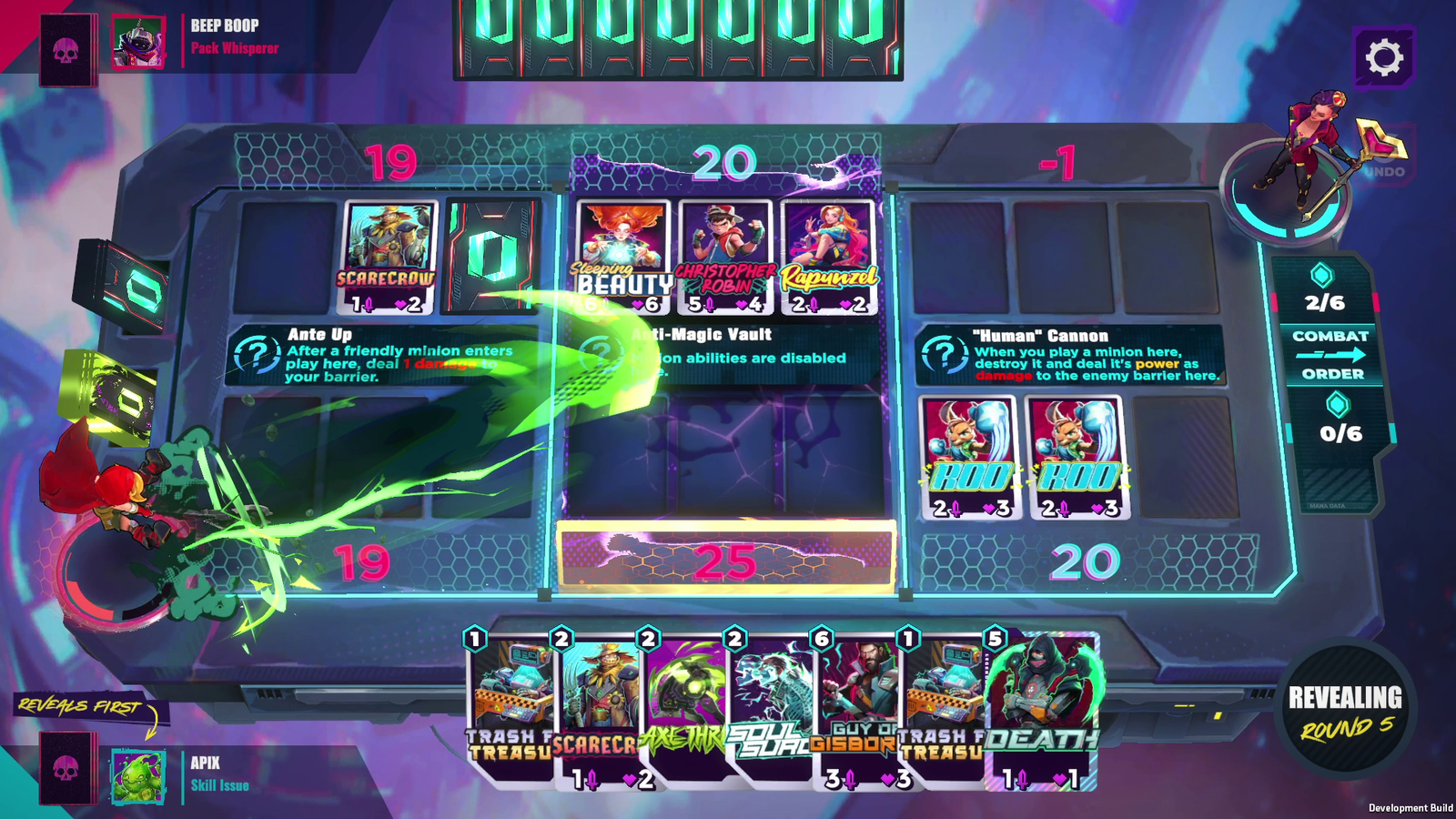
Dans cette capture, les descriptions des lieux se trouvent au centre, les barrières adverses au-dessus et les vôtres en dessous. Votre main est en bas ; les compteurs de mana sont à droite. Lisez le lieu avant de poser une carte : une bonne carte placée au mauvais endroit peut perdre son intérêt.
Avant le premier tour : comprendre votre deck et votre main
Le deck se construit autour d’une carte légendaire et de douze autres choix. Ces douze cartes sont jouées en deux exemplaires : cela donne 25 cartes au total, même si la construction ressemble à treize choix. La légendaire du deck et le personnage cosmétique qui vous représente ne désignent pas forcément la même chose.
Le mulligan vous permet de remplacer des cartes de départ. Cherchez une main que vous pourrez utiliser tôt plutôt qu’une collection de cartes coûteuses. L’aperçu de la légendaire adverse vous donne un premier indice sur le plan à anticiper.
Préparer vos cartes avec le mana disponible
Le mana sert à payer les cartes. Comparez leur coût au compteur disponible ; votre budget évolue au fil des manches et peut être modifié par des effets. Ne supposez pas que du mana non utilisé sera conservé : vérifiez le fonctionnement du lieu et les effets actifs.
Exemple de budget : avec 6 mana disponibles, une carte à 2 et une carte à 4 coûtent ensemble 6. Ce calcul ne dit pas encore si c’est une bonne séquence : vérifiez leurs cibles, leurs places et leurs interactions. Dépenser tout votre mana n’est pas un objectif si cela vous fait perdre une barrière.
Une manche : planifier, révéler, combattre
Planifier : les deux joueurs préparent leurs cartes pendant la même phase. Vous devez prévoir ce que l’adversaire pourrait faire.
Valider : vérifiez les voies, les cibles et le mana avant de confirmer vos actions.
Révéler : les cartes et leurs effets se résolvent selon la priorité du jeu. Regardez l’indication « Reveals First » : une cible peut avoir changé avant votre effet.
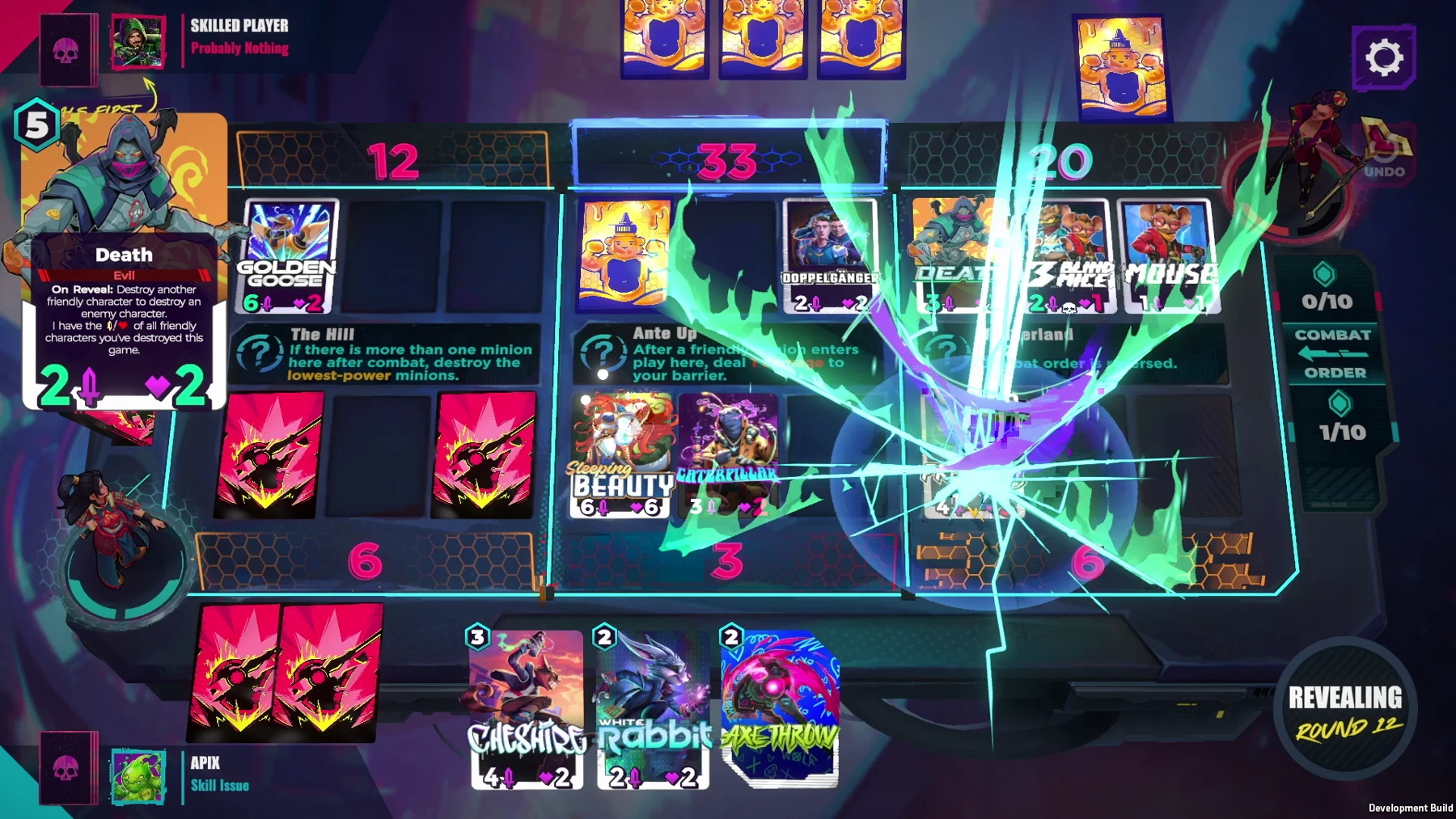
Combattre : les personnages attaquent automatiquement selon l’ordre du plateau. L’indicateur « Combat Order » et la position des cartes comptent ; ce n’est pas une résolution globale où tous les dégâts arrivent ensemble.
Faire le bilan : observez les survivants, les barrières et les effets de fin de combat avant de préparer la manche suivante.
Le développeur Fenchurch a précisé le 29 octobre que le combat avance case par case. Un effet qui crée une carte pendant ce combat peut donc dépendre de l’emplacement où elle apparaît : ne partez pas du principe que toute nouvelle carte pourra attaquer immédiatement.
Puissance, points de vie et attaques
La puissance indique les dégâts d’attaque ; les points de vie indiquent ce qu’un personnage peut subir. Un adversaire placé en face peut bloquer la voie d’attaque. Sans personnage adverse en face, une attaque ordinaire peut toucher la barrière. Les capacités comme First Strike, Double Attack ou Trample changent le résultat : lisez leur explication dans le jeu.
Exemple simplifié : un personnage de puissance 3 qui attaque une cible à 2 points de vie peut la détruire, sans pour autant infliger automatiquement son point de dégât excédentaire à la barrière. Il faut un effet qui le permette, comme Trample, et tenir compte des protections. Évaluez aussi ce que l’adversaire fera avant votre attaque.
Votre vérification avant de valider
Une de mes barrières peut-elle tomber pendant cette manche ?
Le lieu améliore-t-il ou annule-t-il mon effet ?
Qui révèle en premier, et ma cible existera-t-elle encore ?
Que se passe-t-il à l’emplacement de mon personnage pendant le combat ?
Mon action défend-elle mon plan ou sert-elle seulement à dépenser du mana ?
Attack the opponent’s barriers while protecting yours. Two barrier breaks win the game. There are three lanes, but winning is not simply about having a higher total power in two locations at one moment. Characters fight and damage to barriers advances the win condition.
A barrier can reform after it breaks. Track the breaks already scored and the health currently displayed, rather than treating a lane as permanently finished.
Checked on 31 October 2026. The official screenshots below come from Koin Games’ media kit and are marked “Development Build”. They illustrate board areas, not the exact appearance of the current release.
Read the three lanes and their locations
Each lane has a location, your barrier, the opponent’s barrier and character spaces. You have three spaces per lane, giving nine on your side. Location text can change damage, abilities or what happens when a card enters.
In this screenshot, location descriptions run through the centre, enemy barriers sit above them and yours below. Your hand is at the bottom and mana counters are on the right. Read a location before placing a card: the wrong position can undermine an otherwise useful play.
Before the first round: your deck and opening hand
Deck construction uses one Legendary and twelve other card choices. The twelve are included as two copies each, making 25 cards in total despite the thirteen choices in the builder. A deck’s Legendary and the cosmetic character representing you are not necessarily the same thing.
The mulligan lets you replace opening cards. Look for a hand you can use early instead of keeping only expensive plays. The opponent’s Legendary preview gives an early clue about the plan you may face.
Plan around available mana
Mana pays for cards. Compare their costs with your available counter; your budget develops over the rounds and effects can modify it. Do not assume unused mana will be saved: check the location and active effects.
Budget example: with 6 available mana, a 2-cost card and a 4-cost card cost 6 together. That arithmetic does not make the sequence correct: check targets, spaces and interactions. Spending every point is not a useful goal if the play loses a barrier.
A round: plan, reveal, fight
Plan: both players prepare their cards during the same phase. Predict what the opponent might do.
Commit: check lanes, targets and mana before confirming your actions.
Reveal: cards and effects resolve according to the game’s priority. Check “Reveals First”: a target may change before your effect happens.
Fight: characters attack automatically in board order. “Combat Order” and card placement matter; damage is not one simultaneous board-wide calculation.
Review: inspect survivors, barriers and after-combat effects before planning the next round.
On 29 October, developer Fenchurch clarified that combat progresses space by space. If an effect creates a card during combat, its ability to attack can depend on where it appears. Do not assume every newly created card attacks immediately.
Power, health and attacks
Power indicates attack damage; health indicates how much a character can take. An enemy directly opposite can block the attack path. Without an opposing character, an ordinary attack can hit the barrier. Abilities such as First Strike, Double Attack and Trample alter the result: read their in-game explanations.
Simplified example: a 3-power character attacking a target with 2 health can destroy it without automatically dealing its spare point to the barrier. An effect such as Trample must permit that damage, and protection still matters. Also consider what the opponent does before your attack.
Check these before committing
Could one of my barriers break this round?
Does the location improve or cancel my effect?
Who reveals first, and will my target still exist?
What happens at this character’s space during combat?
Does this action serve my plan or merely spend mana?
Nous utilisons des cookies essentiels au fonctionnement du site. Avec votre accord, les cookies Google Analytics nous aident à comprendre les visites. Vous pouvez refuser les cookies optionnels ou modifier votre choix à tout moment.
Essentiels
Always active
Nécessaires au fonctionnement du site et des comptes.
Préférences
Permettent de mémoriser des préférences optionnelles.
Statistiques
Utilisés par Google Analytics pour mesurer les visites après votre accord.The technical storage or access that is used exclusively for anonymous statistical purposes. Without a subpoena, voluntary compliance on the part of your Internet Service Provider, or additional records from a third party, information stored or retrieved for this purpose alone cannot usually be used to identify you.
Marketing
Utilisés pour la publicité et le marketing lorsque ces services sont activés.